Do you ship perfumes, chemicals, batteries, solvents, or aerosols? If so, you are very likely affected by dangerous goods transport regulations, whether you realise it or not.
Every year, thousands of shipments are refused, delayed, or penalised, not because the products themselves are inherently dangerous, but because packaging, documentation, or declaration requirements have not been properly followed. At WES, we have been supporting clients with these challenges for nearly 30 years. Here is what you need to know to remain compliant, regardless of the mode of transport.
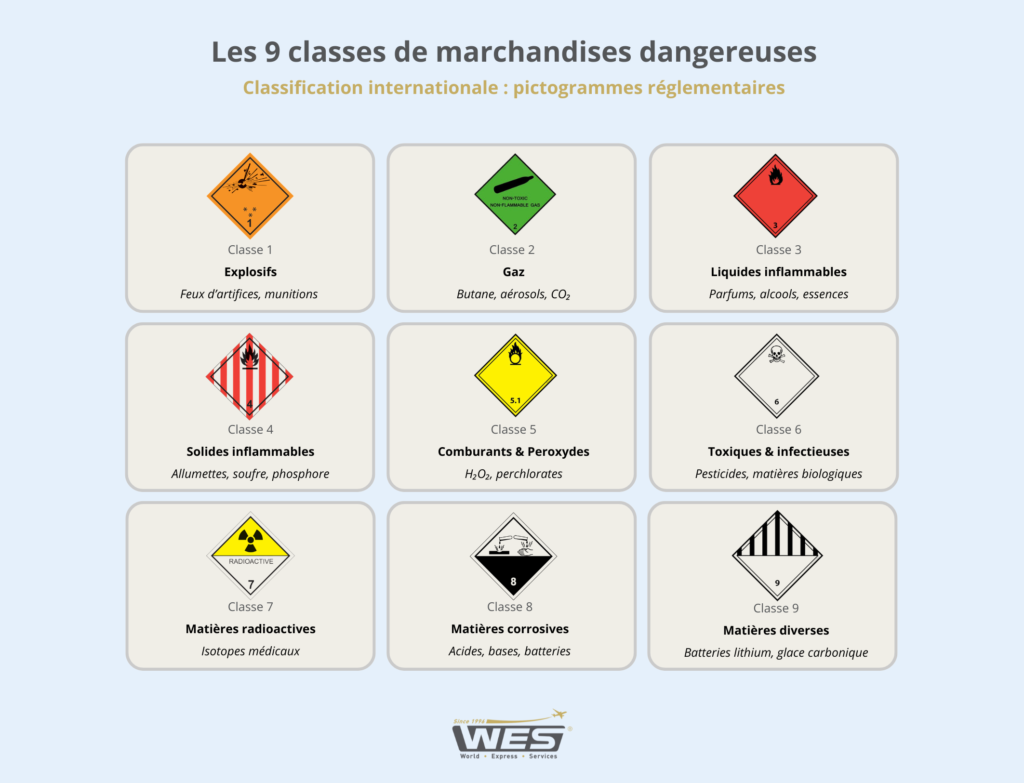
A dangerous good is any substance or article capable of posing a risk to health, safety, property, or the environment during transport. International regulations classify them into nine major hazard classes:
• Class 1: Explosives (fireworks, ammunition)
• Class 2: Gases (butane, aerosols, CO₂)
• Class 3: Flammable liquids (perfumes, alcohols, fuels)
• Class 4: Flammable solids (matches, phosphorus, sulphur)
• Class 5: Oxidising substances and organic peroxides (hydrogen peroxide, perchlorates)
• Class 6: Toxic and infectious substances (pesticides, biological materials)
• Class 7: Radioactive materials (medical isotopes)
• Class 8: Corrosive substances (acids, alkalis, batteries)
• Class 9: Miscellaneous dangerous goods (lithium batteries, dry ice)
Each class has its own requirements regarding packaging, labelling, marking, and documentation. These requirements also vary according to the mode of transport used.
This is one of the points most often overlooked by shippers: there is not one single global regulation, but three separate frameworks, each applicable to a specific mode of transport.
ADR (European Agreement concerning the International Carriage of Dangerous Goods by Road) governs road transport throughout Europe and beyond. It applies whenever a shipment crosses a border by road.
This regulation requires:
• Precise classification of goods according to their UN number
• Approved packaging according to Packing Groups I, II, or III
• Strict package and vehicle marking and labelling requirements
• The appointment of a safety adviser where required
• Mandatory ADR certification for drivers
ADR is updated every two years. The version in force since January 2025 introduced new provisions relating to recycled packaging and lithium batteries. Missing an update can result in border refusals or regulatory penalties.
The International Maritime Dangerous Goods (IMDG) Code is published by the International Maritime Organization (IMO). It applies to all dangerous goods transported by sea, including containerised shipments.
Its requirements include:
• A shipper's declaration, which directly engages the shipper's responsibility
• Segregation rules between incompatible hazard classes onboard vessels
• Compliant Safety Data Sheets (SDS)
• Specific stowage and separation requirements below deck or on deck
The 2024 edition of the IMDG Code strengthened provisions relating to lithium batteries and marine pollutants, categories that are particularly common within the cosmetics, electronics, and industrial sectors.
The IATA Dangerous Goods Regulations (DGR) are the strictest of the three frameworks. Updated every year on 1 January, they precisely regulate what may or may not be transported by air.
IATA requirements include:
• Quantity limits often lower than those permitted by road or sea transport
• Highly specific packaging requirements supported by rigorous certification testing
• A Shipper's Declaration completed with the utmost accuracy
• Mandatory certification training for freight handling personnel
In practice, airlines and handling agents apply IATA rules with virtually zero tolerance. An incomplete declaration or non-compliant packaging will systematically result in refusal of acceptance and may even lead to temporary quarantine of the shipment.
Complexity reaches its highest level when a shipment uses several transport modes in succession. For example, a truck to reach a port, a vessel to cross the Mediterranean, and then an aircraft to reach a final destination.
In such cases, obligations accumulate. The shipment must comply simultaneously with ADR requirements for road transport, IMDG requirements for sea transport, and IATA requirements for air transport, with rules that may sometimes differ regarding packaging or documentation.
Managing these combined flows requires specialist expertise and rigorous coordination between all parties involved.
The consequences of regulatory non-compliance can be significant:
• Refusal of transport or customs clearance
• Detention or destruction of the goods
• Administrative or criminal penalties for both the shipper and the carrier
• Civil liability in the event of an accident or incident
• Damage to the company's reputation and relationships with logistics partners
The good news is that these risks are entirely avoidable when working with trained and experienced specialists.
Since 1996, WES has supported perfume houses, industrial companies, exporters in Monaco, and businesses throughout the region with their dangerous goods shipments.
Our team provides:
Classification and identification
We determine the correct UN number, hazard class, packing group, and applicable quantity limits for each of your products.
Document compliance
Preparation and verification of all regulatory documentation, including ADR, IMDG, and IATA declarations, transport documents, and Safety Data Sheets.
Packaging verification
We ensure that packaging is approved, in good condition, and correctly marked and labelled according to the applicable regulations.
Regulatory monitoring
Our specialists continuously monitor developments in ADR, IMDG, and IATA regulations, ensuring that you are informed of any changes likely to impact your operations.
Our long-standing expertise in the perfume industry, where Class 3 flammable liquids are commonplace, demonstrates our ability to handle sensitive goods with precision, responsiveness, and discretion to destinations worldwide.
Do not let regulatory requirements become an obstacle to your business. Our teams are available to review your transport flows, identify your obligations, and implement solutions tailored to your industry.
Contact us: wescommercial@wes.mc
Share this article on :