✔ Incoterms 2020 remain in force in 2026.
Published by the International Chamber of Commerce (ICC) on 1 January 2020, they definitively replaced Incoterms 2010. No new version is currently planned.
Every year, thousands of international contracts are poorly negotiated, not because of the price, but because an Incoterm has been incorrectly selected or misunderstood. EXW, FOB, CIF, DDP... These three-letter terms define precisely who pays for what, and who is responsible for what, throughout an international transaction. For SME managers involved in international trade, understanding them is not optional: it is a direct competitive advantage. This practical guide provides all the keys you need to understand, compare, and select the right Incoterm for every situation.
An Incoterm (International Commercial Term) is a standardised rule published by the International Chamber of Commerce (ICC) that defines, within an international sales contract, the allocation of responsibilities between seller and buyer regarding three key aspects:
• Responsibility for logistics costs (transport, insurance, loading and unloading)
• Transfer of risk (loss, damage, theft of goods)
• Management of customs formalities (export and import)
The current version, Incoterms 2020, contains 11 rules divided into two categories:
• 7 rules applicable to all modes of transport (EXW, FCA, CPT, CIP, DAP, DPU, DDP)
• 4 rules reserved for sea and inland waterway transport (FAS, FOB, CFR, CIF)
If you previously worked with Incoterms 2010, here are the key changes introduced in the 2020 version:
• DAT replaced by DPU: the DAT (Delivered At Terminal) rule was renamed DPU (Delivered at Place Unloaded). The change is primarily semantic, as unloading can now take place at any agreed location rather than exclusively at a terminal.
• Enhanced insurance requirements under CIP: under CIP (Carriage and Insurance Paid To), the minimum insurance requirement was upgraded to Institute Cargo Clauses A (all risks), compared with Clause C (basic risks) under the 2010 version. CIF continues to require only Clause C coverage.
• On-board bills of lading authorised under FCA: in documentary credit transactions, FCA now allows the buyer to request an on-board bill of lading even when the transfer of risk occurs before loading. This flexibility has been widely welcomed by international trade professionals.
• Possibility of using own means of transport: FCA, DAP, DPU and DDP now explicitly allow the seller or buyer to organise transportation using their own vehicles rather than a third-party carrier.
This table summarises the key characteristics of each Incoterm.
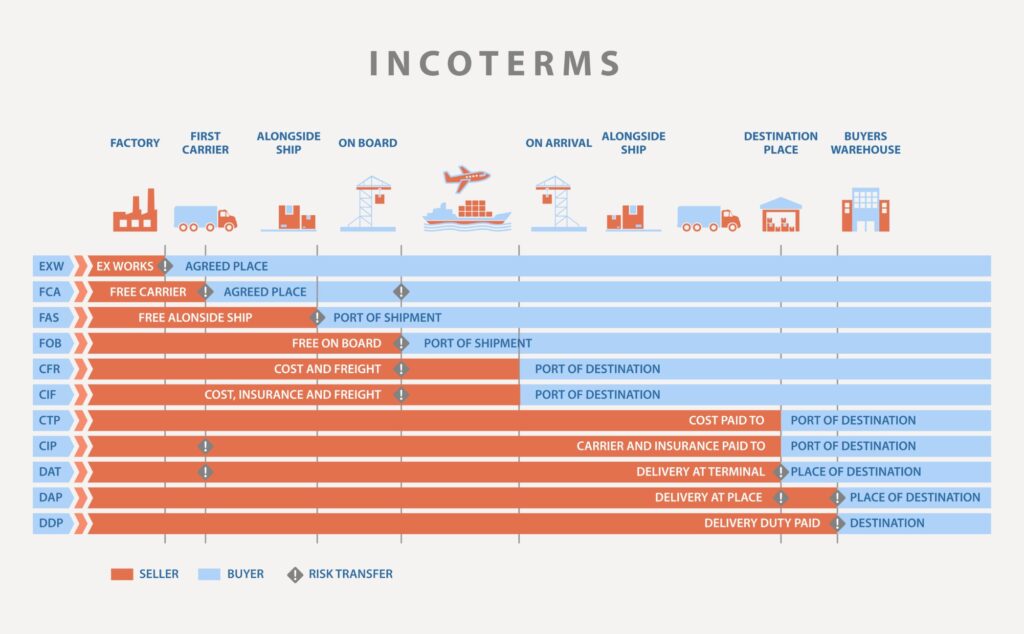
Under EXW, the seller has only one obligation: making the goods available at their premises. The buyer is responsible for loading, international transport, export and import customs formalities, and assumes all risks from collection onwards.
Seller advantage: no logistical obligations after making the goods available.
Buyer disadvantage: maximum complexity, requiring a competent freight forwarder in the seller's country.
Hidden risk: the seller may encounter difficulties proving export for customs purposes because the buyer is responsible for the export declaration. This can create VAT recovery and tax compliance issues.
💡 Tip: EXW is generally best suited to transactions between geographically close companies or where the buyer already has a well-established logistics network in the seller's country. For most export operations, FCA is often a better choice.
FOB is one of the most widely used Incoterms in international maritime trade. The seller covers all costs up to loading the goods onto the vessel at the port of departure. The buyer then assumes responsibility for ocean freight, insurance, and import customs formalities.
Transfer of risk: when the goods are loaded on board the vessel at the agreed port of shipment.
Advantage: a balanced distribution of responsibilities that is widely recognised by banks and insurers.
Important: FOB is reserved exclusively for sea and inland waterway transport and should not be used for multimodal or air transport.
💡 Tip: if your goods are transported in containers, FCA is generally preferable to FOB. In container shipping, goods are handed over to the carrier or terminal operator well before loading onto the vessel. Using FOB creates a potential gap in responsibility between delivery to the carrier and actual loading. FCA reflects operational reality more accurately.
CIF is frequently requested by buyers because it appears reassuring: the seller pays for freight and insurance. However, the transfer of risk occurs when the goods are loaded on board at the port of departure, not upon arrival.
The buyer therefore bears the transit risk, while the seller only provides minimum insurance coverage under Clause C.
Transfer of risk: when loaded on board at the port of departure.
Mandatory minimum insurance: Institute Cargo Clauses C (basic risks only).
Key point: the buyer has no control over the quality of the insurance arranged by the seller.
⚠ SME warning: many buyers mistakenly believe that under CIF the seller remains responsible until the goods arrive at destination. This is incorrect. In the event of a maritime loss, the buyer must rely on the insurance policy arranged by the seller for their benefit. Always verify the policy conditions.
DDP places the greatest level of responsibility on the seller. The seller delivers the goods to the agreed destination with customs duties paid.
While attractive for the buyer, DDP requires the seller to manage import customs formalities in the buyer's country, which can be highly complex.
Buyer advantage: turnkey delivery with no logistical procedures to manage.
Seller risk: responsibility for import VAT, local importer registration requirements, and regulatory compliance.
Typical use case: international B2C e-commerce and sectors where buyers have limited logistics capabilities.
💡 Tip: before agreeing to DDP terms, verify that you are legally authorised to import into the buyer's country and that you fully understand the applicable customs duties and regulations. A customs classification error can result in significant liability.
There is no universally superior Incoterm. The right choice depends on your specific circumstances.
Question 1: Who has the greatest control over the logistics chain?
This is the fundamental question. Responsibility for transport and customs should be assigned to the party with the strongest expertise in the relevant market.
Question 2: Which mode of transport is being used?
FOB, CFR, CIF and FAS are reserved exclusively for maritime and inland waterway transport. For air freight, road transport or multimodal operations, use FCA, CPT, CIP, DAP, DPU or DDP.
Question 3: What is your appetite for risk?
The earlier the transfer of risk occurs (EXW, FCA), the less exposure the seller retains. The later it occurs (DAP, DDP), the more risk remains with the seller.
Question 4: Are you using a documentary credit?
In documentary credit transactions, banks often require an on-board bill of lading. FCA (since Incoterms 2020) and FOB can meet this requirement.
Question 5: What is the balance of commercial power?
Your ability to impose an Incoterm often depends on your negotiating position. Large buyers frequently require EXW or FCA terms, whereas suppliers in a stronger position may negotiate DAP or DDP.
An Incoterm defines the transfer of costs and risks, not ownership of the goods. Ownership transfers according to the sales contract or applicable law.
In container transport, goods are handed over to the freight forwarder or terminal operator before loading onto the vessel. FCA is generally more appropriate.
Under CIF, the seller provides only minimum insurance coverage. Buyers should always verify whether additional insurance is required.
Under EXW, the buyer is responsible for export declarations. This may create VAT recovery issues for the seller. FCA is often preferable because the seller remains responsible for export customs clearance.
Every Incoterm must be accompanied by a clearly defined location.
"FOB" alone is insufficient.
Write: "FOB Port of Le Havre, Incoterms® 2020".
Without this precision, disputes may arise regarding the exact point at which responsibilities transfer.
Mastering Incoterms 2020 goes beyond understanding their theoretical meaning. It means controlling logistics flows, anticipating risks, and ensuring flawless operational execution.
In demanding environments involving tailored transport solutions and sensitive or high-value goods, the choice of Incoterm becomes a genuine tool for risk management and optimisation. A clearly defined framework helps avoid uncertainty, streamline operations, and maintain the expected level of service.
At WES, we support our clients far beyond transportation itself:
• Analysis and clarification of logistical responsibilities
• Securing sensitive operations
• Operational advice when selecting transport conditions
Our objective is simple: to ensure complete control of your logistics flows, from collection through to final delivery.
Share this article on :